
You know the Monday. The crew rolls in, coffee in hand, and the laydown looks wrong. The wire that came Friday is gone. So are the fittings from the gang box. Your electrician stands at the tailgate with nothing to pull, and the drywall sub is waiting on the electrician.
“Came back Monday... fence was gone.”
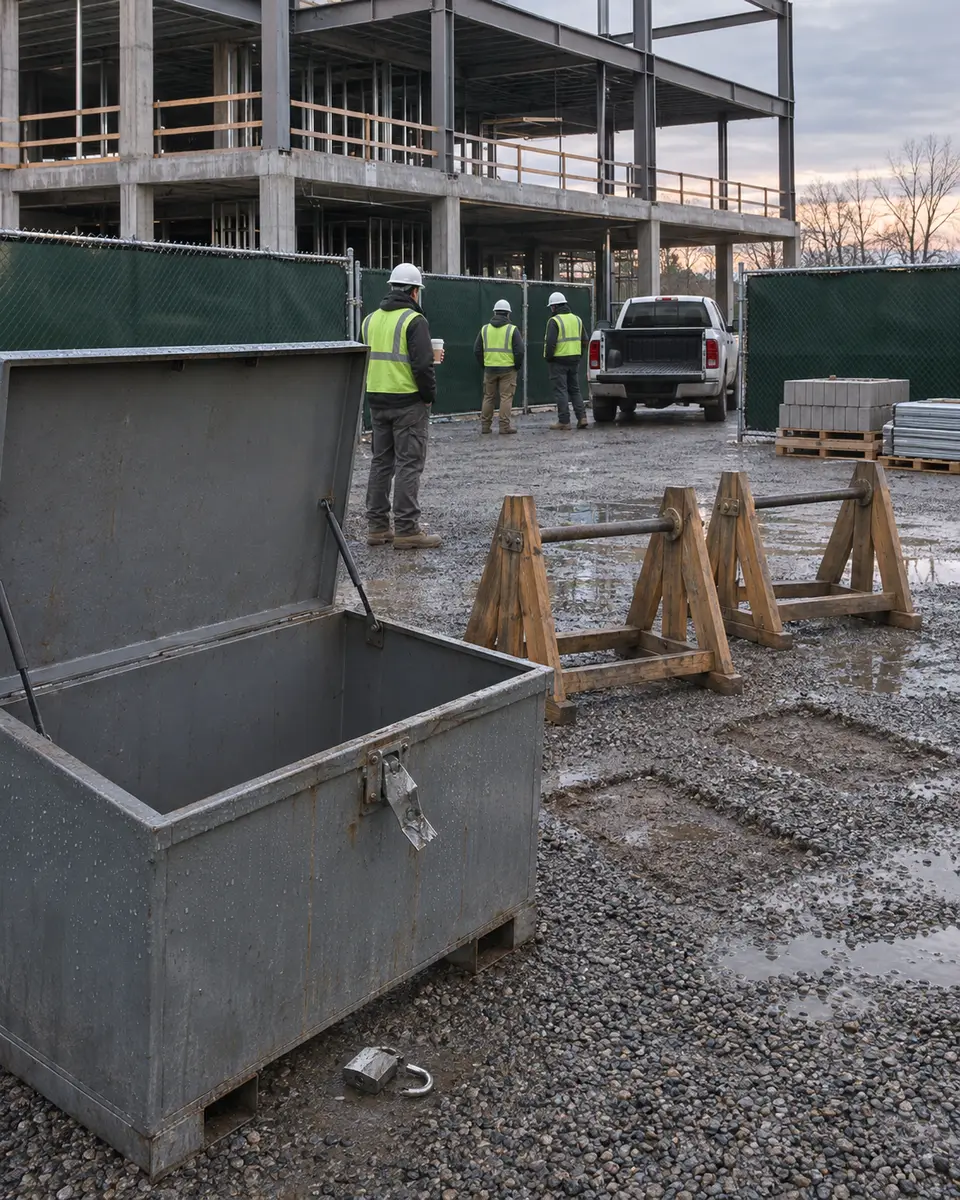
Maybe you’ve made your peace with it:
“it’s just chalked up to the cost of doing business”
That’s fair. On a big job, stolen material may already be in the budget. A field superintendent says the same about the money:
“losing the money sucks and all... We’ve planned for it or we’ll make it up.”
What hurts, in the same superintendent’s words, is “the time it costs.”
The money comes out of a line item. The time comes out of your schedule. One roofing contractor counted both, after shingles were dropped on a job the day before:
“40 squares worth of materials and a days work lost.”
A single incident can cause major project delays, missed deadlines, and insurance complications. So on that Monday, what did it really cost you: the wire, or the week?
And it may not end at one trip. Same roofer, same job:
“They came back and stole the rest of it at 4 this morning.”
The second trip lands on the same bill as the first. So whose bill is it?
You may figure it’s the owner’s building, so it’s the owner’s loss. That’s a fair read of who’s paying for the job. Here’s how one public owner writes it, in its standard contract:
“the Contractor shall be under an absolute obligation to protect the finished and unfinished Work against any damage, loss, injury, theft and/or vandalism”
Replaced or repaired “at the Contractor’s sole cost and expense”.
Source: City of New York, Standard Construction Contract, Article 7.1, March 2017 version
That’s New York City’s form, not every contract, so read your own. Under language like that, until final acceptance, a theft is yours to prevent and yours to pay for. Finished and unfinished.
For a contractor’s own property, a federal master specification says it in one line:
“Contractor is responsible for security of their property.”
Source: UFGS 01 50 00, federal master specification, August 2026
The security budget, though, often sits with the site’s owner or developer, and people who run jobs say so plainly:
“I’m not installing it unless the owner pays for it or if my subs start complaining about theft”
Fair. That’s a conversation for the owner’s table, and it goes better with a written security plan in your hand. The free remote assessment gives you one, yours to keep.
So if the loss is yours, who’s looking after the job in the hours your crew isn’t there?
Construction site security is about the people who show up after your crew leaves. Construction sites are prime targets once crews leave for the day. Valuable materials, machinery, and tools are often left exposed. That means overnight, on weekends, and holidays.
Picture Friday afternoon. The last sub locks the gate, and the job sits there until Monday. With no overnight staff on site, that leaves it open to:
- Theft of materials and equipment
- Vandalism to structures and machinery
- Trespassing and safety hazards
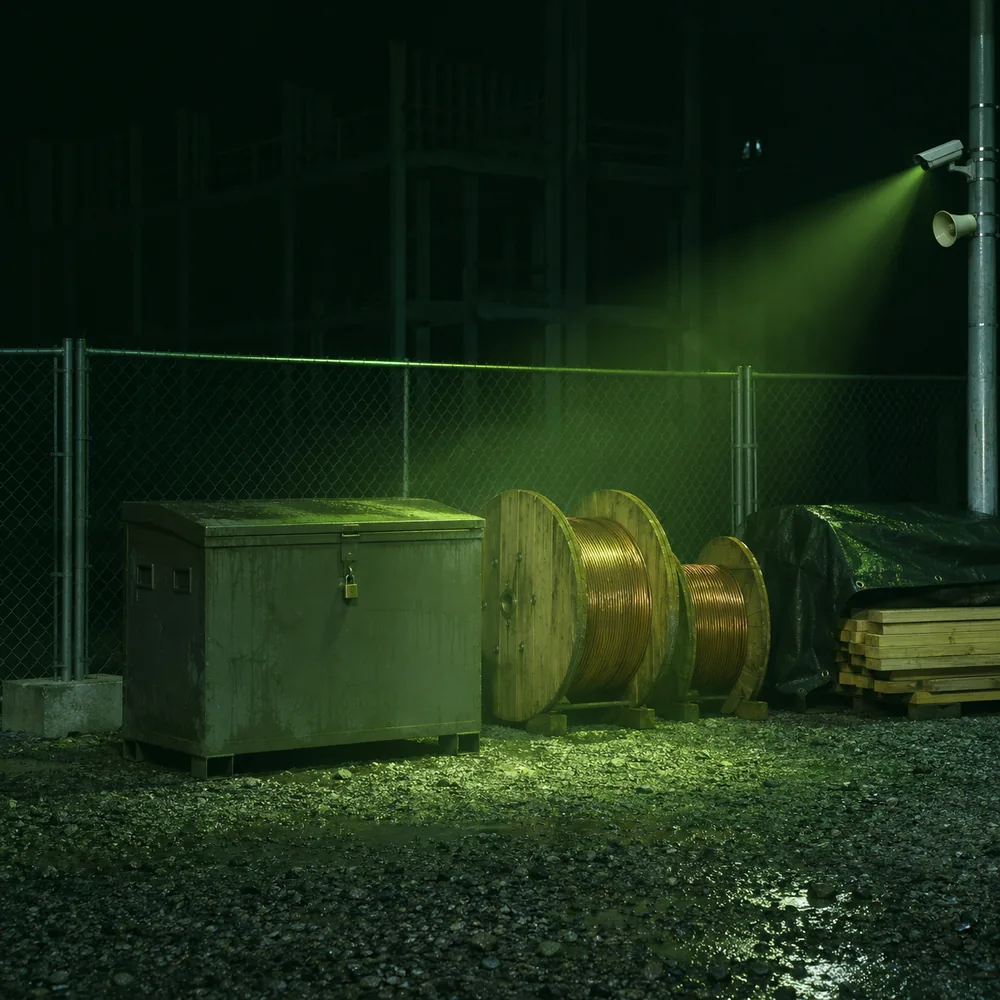
So you lock up what you can. Good crews get clever about it:
“Now we have concrete deadmen that get put in front of every box and the lifting lug goes home with the super.”
That’s smart. Chain it, lock it, track it, put it in the truck. Do all of it.
Now look at what can’t ride home. The pallets in the laydown. Wire pulled through the walls. Units already set. Here’s one worker’s list of what got taken:
“bobcat attachments, materials, installed HVAC condensers”
Installed, and gone. The lug goes home with the super. Does the building?
So you put cameras up. Here’s what they give you, and what they leave in your hand.
Your cameras are up. The app is on your phone. That’s a practical way to keep an eye on a job, and cameras keep a record you’ll want.
Maybe you’ve said it yourself: cameras don’t stop anyone. Look at what they’re for. Traditional security cameras and surveillance systems only record what happens. You find out after the damage is done.
A construction insurer puts it this way: “It’s not possible to have eyes everywhere.” It says cameras deter and provide “evidence for police in case of an incident.”
Source: Builders Mutual, “Preventing Theft Before It Happens,” October 2026
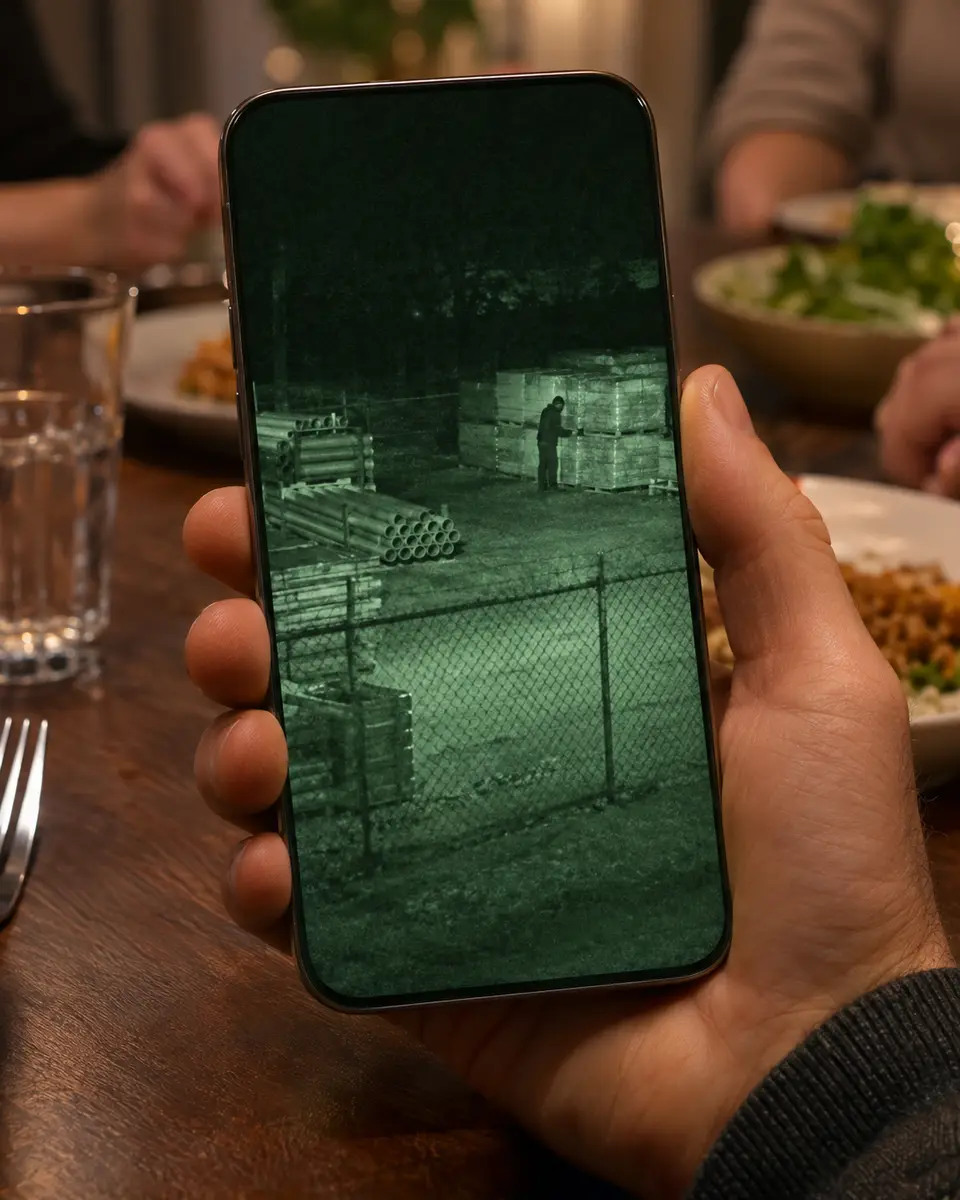
Evidence is for afterward. So you watch the feed yourself.
Picture the phone in your hand. Saturday, dinner with the family, and it buzzes on the table. Motion, the laydown. You open the app. Is that a person by the pallets? Could be. You’re forty minutes out.
“if they go off at 2am in the morning what can ya do by the time ya get to the site they’ll be gone”
So you call it in. One site worker described the wait:
“they won’t show up for at least 30 minutes to an hour”
That’s one worker’s account. Either way, the phone is in your hand, and nobody at the site has said a word.
So was it ever the camera? Or was it that nobody was on the other end of it?
Contractors who pay someone to watch their cameras put it plainly:
“the most important part of the whole thing is they watch the cameras during non work hours”
“We had a few break in attempts stopped by the people on the load speaker”
Here’s what each thing on your site does well, and what construction site security monitoring adds:
| What it does well | What we add | |
|---|---|---|
| Your cameras and phone alerts | See the site, keep the record, tell you something moved | A trained agent on the feed who warns intruders off. You still get the alert and the footage |
| Locks, fences, GPS, taking it home | Slow intruders down and keep what can go home off the site | Someone watching what has to stay on site |
| A guard on site | A real person on site who can respond in person | An agent on your cameras, with your guard in the reporting group |
| A trained Blinkless agent on your cameras | Reviews activity live, warns intruders off, reports incidents in real time | A live operator. Your cameras, locks and guard all stay |
This time, picture Saturday with us on it. Activity at the laydown. A trained agent is alerted and is live on your cameras within seconds. The warning goes out over your speakers: a live voice, loud, ordering the intruders off, and we handle it until they leave. You get the alert with footage. You finish dinner.
That’s the person we add. Here’s exactly what they do.
Here’s construction live video monitoring the way we run it, in the hours you choose. In most cases it runs on the cameras you already have, and typically only speakers need installing. We integrate existing cameras or install new ones. See how remote video monitoring works on the cameras you already have.
Activity on site.
AI detects activity and live operators verify events. When a potential threat is detected, a trained agent is alerted immediately.
A person on your cameras.
Within seconds, the agent is live on your video monitoring feed.
A live voice.
We order intruders to leave over your speakers. It’s a live person, not a prerecorded message, and the warning goes out right away, with no drive-out to wait for.
Until they leave.
We handle it until the intruder leaves, and we notify authorities when required. If an intruder refuses to leave, contacting the police is our standard protocol, and protocols can be customized for your site.
We tell you what happened.
Incidents are documented and shared with project managers and construction foremen in real time, through a reporting group. You get alerts with footage, and reports.
What live monitoring looks like on a real construction site
This is a real construction site we watch.
- Under 30 seconds: average response time
- 3,000+ break-ins prevented
- Up to 70% lower cost than traditional on-site guards: a person on your cameras, without the cost of one on site
Here’s how one builder running several jobs put it.
“As a growing construction company managing multiple job sites, we struggled to find a practical way to keep eyes on everything after hours. Traditional security guards couldn’t be everywhere at once, and the costs were adding up. We turned to Blinkless to bridge that gap, and their remote monitoring system has made a real difference. With full visibility across all sites, we now prevent unauthorized access, vandalism, and material theft. Blinkless gives us reliable data, immediate alerts, and the confidence that our sites are being looked after.”
Several locations go on one contract, under one billing address.
You’re not the only one. Here’s how two contractors put it:
“Just had someone steal a skid steer from right under a job site security camera. Caught the whole thing and we know nothing.”
“We had another site with a security guard. Our side-by-side still got stolen.”
A camera keeps the record, and a guard can respond in person. But a camera can’t speak up on its own, and a guard can only be in one place at a time. We add the voice on your cameras: a trained operator reviews your live feed, decides, and orders intruders off over your speakers.
You don’t have to take our word for it. Here’s what you can check:
- Before you sign. Your free written security plan sets out how intruders and break-in attempts would be handled, and who gets alerted. It’s yours to keep.
- After an incident. You get alerts with footage, and reports, in your site’s own reporting group. If you have a guard, they join it too.
- If a camera goes offline. We know at once, and we tell you in your reporting group.
So does it fit your site?
Unlike permanent properties, construction sites change daily. New access points, temporary fencing, and evolving layouts make consistent security difficult. So your free remote assessment covers your site as it is, from satellite imagery and your existing cameras. As the job grows, we can add cameras and speakers.
- Cameras already up? In most cases, yes. We can integrate with many existing surveillance systems, and typically only speakers need installing. No cameras yet? We install new ones.
- Your hours. You choose them. Overnight, on weekends, on holidays: active monitoring when the crew is gone.
- A guard on site? Your guard stays and joins the reporting group. We work alongside.
- Several jobs? One contract, one billing address.
- No power or internet? As one builder put it: “I rarely have temp power and never WiFi.” We support solar cameras with customized, trailer-like setups where a site has no electricity or internet. Each camera gets its own SIM card, and the solar setup can include a speaker. Your free remote assessment looks at what your site needs.
Whatever else is on your site today, tell us in the form. We start from what you tell us.
If it’s parked machines in a yard that worry you most, see equipment yard remote video monitoring.
Site prep.
Open ground, and often no power yet. We install new construction site security cameras or work with yours. Where there’s nothing to plug into, we put up a solar camera setup.
While you build.
A new laydown, a new gate: we add cameras and speakers where the work moves. Need one in a new spot on the site? We move it on a service call.
Until the job is done.
In the hours you choose, a trained agent on those cameras warns intruders off over the speakers and calls police when needed.
Want to see your own site’s risk on paper first?
Build a construction site security plan for your jobsite in about three minutes. You get a scored risk assessment, ranked actions, a personalized checklist, and a printable document for the owner or GC. It’s free, with no sign-up, and nothing leaves your browser.
What builders ask before they start
Can you do remote construction site monitoring on the cameras I already have?
In most cases, yes. We can integrate with many existing surveillance systems, and typically only speakers need installing. No cameras yet? We install new ones. If your cameras can’t connect, we can install new ones in their place. Tell us what you have in the form.
What if it’s my own super on site after hours?
You choose the hours we cover. And an agent reviews the live feed before anything goes out over your speakers: AI detects activity and live operators verify events. The warning is for intruders.
Your people don’t have to step in. One site worker’s company told them where it stands:
“I’ve been ordered by my company not to do anything”
The warning comes from us.
What does it cost?
Up to 70% lower cost than traditional on-site guards. For your own site, start with the free remote assessment.
Our contract names an on-site guard. Does that change anything?
Keep the guard. Some specifications name one. San Diego’s guide specification lists “a full time security bonded guard 24 hours a day” among the levels of security its specifier can select. For airport work, Los Angeles World Airports says the contractor “shall provide security guards at laydown area entrance and gates” it uses through the airport’s perimeter security fences, when those gates must be open for its vehicles. Where a contract names a guard, the guard stays and we work alongside, on your cameras, with your guard in the reporting group.
Source: City of San Diego, guide specification Section 01521; Los Angeles World Airports, 17-2.3
Do I need approval for cameras on a public job?
On some public jobs, yes. The City of San Diego’s guide specification says: “The CONTRACTOR shall not allow cameras on site, or photographs to be taken except with prior approval of the OWNER or CONSTRUCTION MANAGER.” So check yours and get the approval first.
Source: City of San Diego, guide specification Section 01521, 1.3
We build in Florida. Does posting the site matter?
It can. Under Florida law, trespass on a construction site is a third-degree felony where a site over 1 acre is “legally posted and identified in substantially the following manner”: “THIS AREA IS A DESIGNATED CONSTRUCTION SITE, AND ANYONE WHO TRESPASSES ON THIS PROPERTY COMMITS A FELONY”. At 1 acre or less, the site needs a sign that “appears prominently, in letters of not less than 2 inches in height” and reads in substantially the same manner, placed “at the location on the property where the permits for construction are located”. It’s worth checking before the job starts. Ask your attorney how it applies to your site.
Source: Florida Statutes 810.09(2)(c), The 2026 Florida Statutes
Which hours can you cover?
We run remote guarding for construction sites 24/7, and you choose the hours your job needs: overnight, on weekends, on holidays.
Who hears about an incident, and when?
You do. We tell you the moment something happens. Incidents are documented and shared with project managers and construction foremen in real time, through a reporting group. You get alerts with footage, and reports, and we notify authorities when required. Your written security plan sets out who gets alerted.
Sources
- City of New York, Standard Construction Contract, Article 7.1 (March 2017 version)
- UFGS 01 50 00, federal master specification, August 2026
- City of San Diego, guide specification Section 01521
- Los Angeles World Airports, specification 17-2.3
- Builders Mutual, “Preventing Theft Before It Happens,” October 2026
- Florida Statutes 810.09(2)(c), The 2026 Florida Statutes
- Buyer quotes: contractors and site crews in their own words, trimmed; role only
Your free remote assessment starts from satellite imagery and your existing cameras, with no site visit. You get a written security plan covering what needs monitoring, during which hours, how intruders and break-in attempts would be handled, and who gets alerted.
The plan is yours to keep, whether you hire Blinkless or not. Protect your project from day one.
- Tell us about the site in the form.
- We assess it remotely, from satellite imagery and your existing cameras.
- You get your written security plan, yours to keep.
Blinkless remote video monitoring for construction sites: trained agents on your cameras, warning intruders off over your speakers, across the USA and Canada.